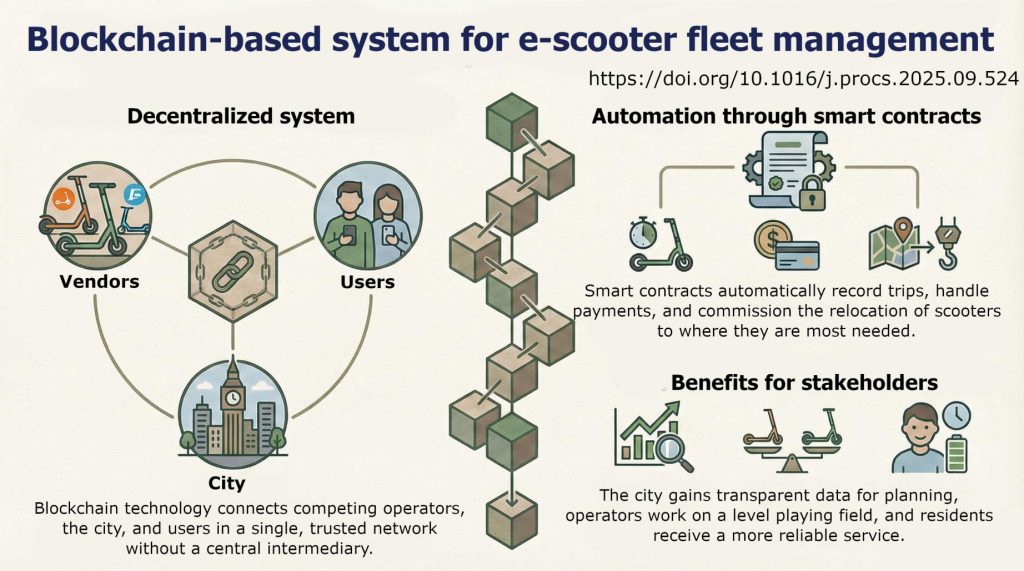
Urban micro-mobility based on shared e-scooter systems, while effective in terms of ecology and traffic reduction, faces significant barriers in coordinating the activities of multiple independent operators. Issues such as inefficient vehicle distribution, fragmented data, and a lack of trust between competing companies became the impetus for research conducted by Dr. Elżbieta Lewańska and Dr. Piotr Stolarski from the Department of Information Systems. The result of their work is the article titled “Transparent e-scooter fleet management with blockchain“, which was presented at the KES 2025 conference and published in Procedia Computer Science (open access).
The authors propose moving away from traditional, centralized management models in favor of a decentralized blockchain architecture. The use of smart contracts allows for the automation of processes that previously required intermediaries or complex data exchange. The developed system enables:
- Transparent tracking of fleet availability and usage in real-time.
- Automatic payment settlement and infrastructure cost management (e.g., charging stations) in a tamper-proof manner.
- Dynamic fleet rebalancing, meaning the generation of signals to move vehicles to where there is real demand, which optimizes urban logistics.
The system design was not limited to the theoretical sphere. In accordance with the Design Science Research (DSR) methodology, the researchers developed a prototype that was tested using real data from e-scooter trips in Chicago. Experiments conducted on the Ethereum blockchain confirmed that the system is capable of efficiently processing a high volume of transactions while maintaining operational costs (so-called gas fees) at an economically justified level.
The publication identifies blockchain as a technology that enables the construction of a neutral and secure collaboration platform for public and private entities. This solution can significantly contribute to organizing urban space and increasing the reliability of micro-mobility services.
The full text of the article is available on ScienceDirect: doi.org/10.1016/j.procs.2025.09.524