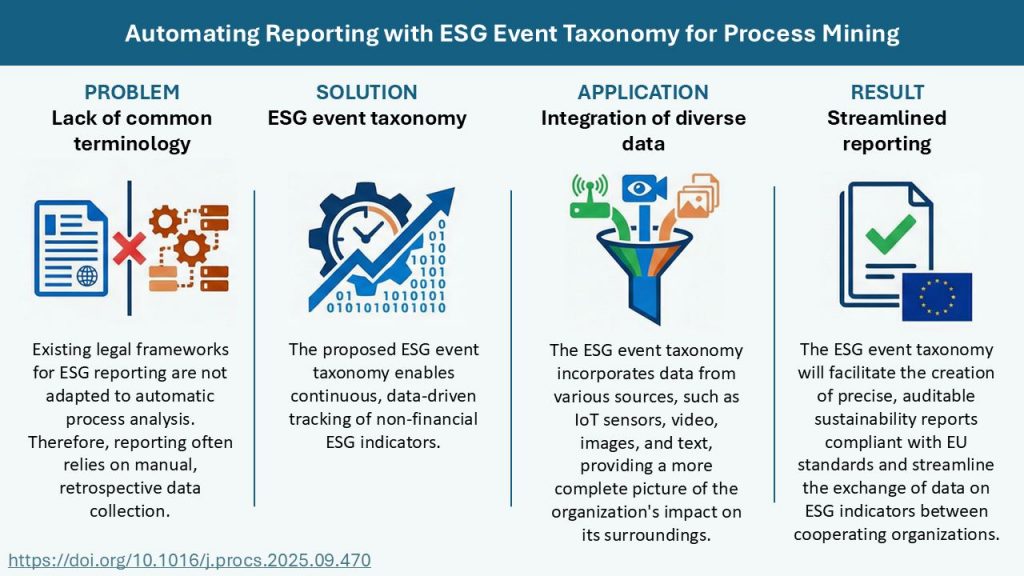
In the face of growing regulatory requirements from the European Union, reporting on environmental, social, and governance (ESG) issues is becoming one of the key challenges for modern business. Since 2024, large enterprises in the EU have been required to publish detailed reports regarding their impact on the environment, which creates a need to develop more effective and reliable methods of data collection. The latest publication by researchers from the Department of Information Systems is an answer to these needs.
Dr. Elżbieta Lewańska and Dr. Milena Stróżyna presented the article “Enhancing ESG Reporting Through Process Mining: A Taxonomy of ESG Events” at the KES 2025 conference. This work, published as open access in Procedia Computer Science, proposes using process mining technology to automate the reporting processes of ESG indicators.
The main scientific contribution of the study is the creation of a structural taxonomy of ESG events. Currently, many companies base their reports on manual, retrospective data collection, which is a time-consuming and error-prone process. The authors propose shifting to a data-driven model that allows for the tracking and analysis of ESG results in real time.
The innovation of the proposed approach lies in the integration of multimodal data. This means that the monitoring system can draw information from diverse sources:
- IoT sensor logs and smart meters: monitoring energy consumption and emissions in real time.
- Image and video analysis: detecting violations of occupational safety standards or pollution leaks.
- Textual and structured data: analysis of compliance reports and documentation from suppliers.
The proposed taxonomy has been aligned with the European Sustainability Reporting Standards (ESRS). This allows companies to precisely map specific indicators (e.g., carbon footprint of production, water consumption, or ethics in the supply chain) to individual stages of business processes.
The practical utility of the model was verified using the example of a hypothetical manufacturing process. It was shown that thanks to a better understanding of ESG events within operations, organizations can not only fulfill regulatory obligations more efficiently but also implement so-called eco-innovations. This allows for proactive management of sustainable development instead of merely passively reporting past events.
These studies represent an important step towards modern, digital ESG management, where technology supports transparency and genuine business responsibility.