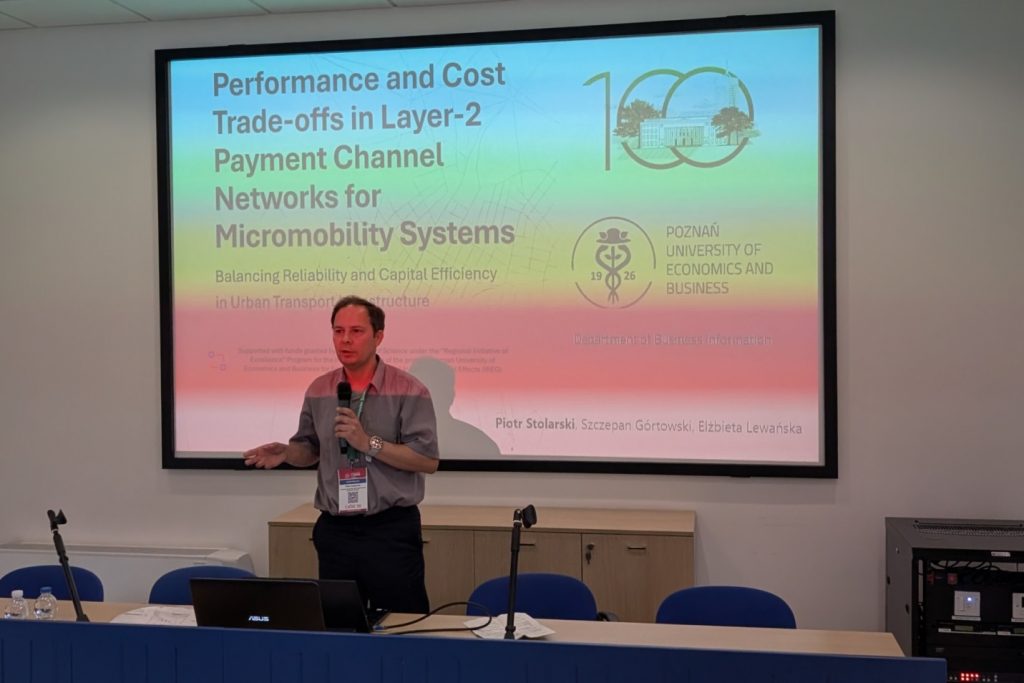
At the international scientific conference CAiSE 2026 (38th edition of the International Conference on Advanced Information Systems Engineering), our researchers presented a paper exploring how blockchain technology can efficiently support the millions of microtransactions generated every day by users of shared electric scooters. The conference was held from June 8 to 12, 2026, in Verona, Italy.
 In their study, the researchers investigate how to balance processing speed and operational costs in urban mobility systems. Modern micromobility services, such as shared electric scooters and bicycles, rely on an enormous number of small-value transactions, often charged every minute of a ride. As these services become increasingly popular, the number of transactions that must be processed continues to grow. Although blockchain technology provides transparency and data security, its base layer (Layer 1) is not designed to handle such transaction volumes efficiently due to limited throughput, relatively high costs, and slower processing speeds.
To address this challenge, the authors propose using Layer-2 technology, which moves the majority of transactions off the main blockchain. In practice, microtransactions are executed through payment channels established between users and service operators, while only aggregated settlements are recorded on the underlying blockchain. This approach significantly improves system performance and reduces operating costs while maintaining the security and auditability of transaction data.
 The researchers developed a prototype system based on a private Ethereum network together with real nodes of a selected Layer-2 payment network. The evaluation was performed using data reflecting actual electric scooter trips in a large city, allowing the experiments to reproduce realistic operating conditions. The results showed that payment success rates increase as more funds are allocated to payment channels, but only up to a certain point. Beyond this threshold, additional funds become effectively “locked” in the channels, reducing the system’s economic efficiency.
The study also demonstrated that the operating costs of the system depend primarily on the number of payment channels closed on the blockchain rather than on the number of individual transactions. This means that closing channels after every ride is inefficient, whereas aggregating multiple transactions into a single settlement can substantially reduce costs. At the same time, attempting to maximize system reliability results in rapidly increasing costs and requires large amounts of capital to remain locked in payment channels. Consequently, the key challenge is to find the right balance between reliability and economic efficiency. Appropriate load distribution across the payment network and the use of aggregated settlements are among the most important mechanisms for achieving this balance.
The paper, entitled “Performance and Cost Trade-offs in Layer-2 Payment Channel Networks Using Real Raiden Nodes on Private Ethereum“, has been published by Springer. Authors: Dr. Piotr Stolarski, Dr. Szczepan Górtowski, Dr. Elżbieta Lewańska.