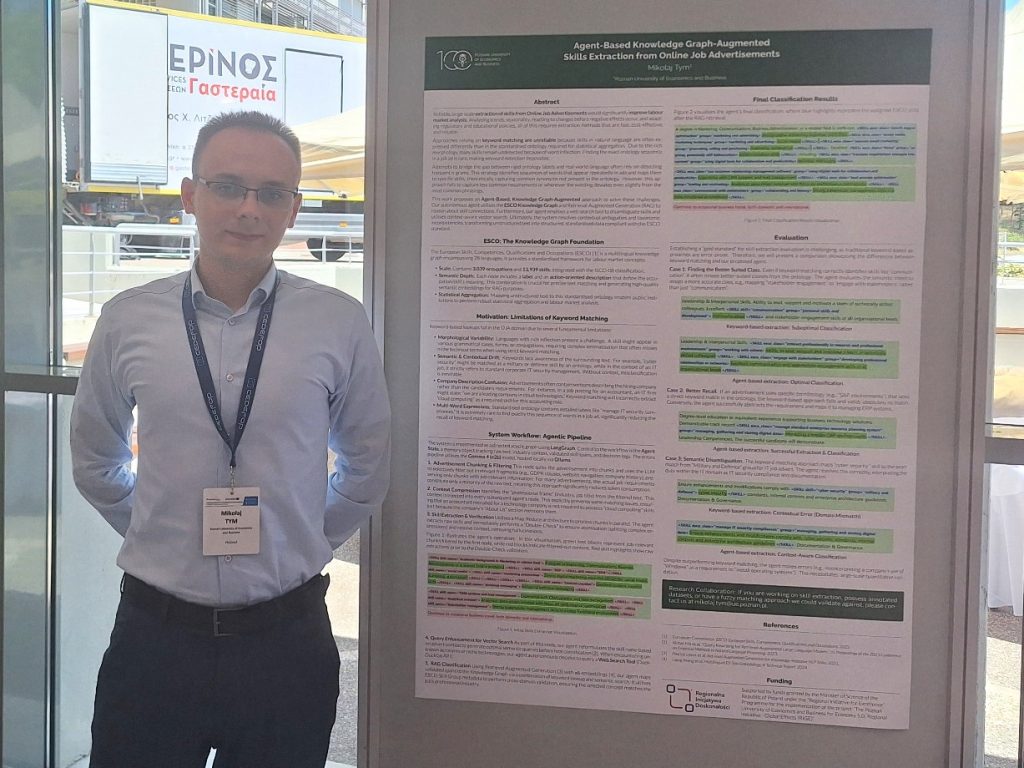
During the international conference “Harnessing web data for next-generation skills intelligence”, organized by the European Centre for the Development of Vocational Training (CEDEFOP) and Eurostat, Mikołaj Tym, a researcher from our department, presented his findings on extracting information from online job advertisements concerning the skills required by employers using an AI agent-based approach. The event took place on May 28 and 29 in Thessaloniki, Greece.
Traditional methods based on keyword matching to identify skills demanded by employers are unreliable due to the complex morphological variability of natural language and the specific multi-word expressions used in standardized databases. The approach proposed by our researcher relies on an AI agent-based system. Instead of blindly matching keywords, the agent performs multi-step extraction tasks, such as filtering out irrelevant fragments, identifying the industry context, extracting skills, and standardizing them based on the ESCO knowledge graph.
Due to the vast number of possible classes, performing this task manually is highly error-prone. While the AI-driven process ensures reliable results, it is computationally intensive. Therefore, this solution can be applied to verify the quality of other methods in this field or to process relatively small datasets.
Reliable, large-scale extraction of this information allows for tracking labor market trends regarding skill and competence demands. Aggregating these data for public statistics institutions could help shape social, educational, and economic policies based on current, real-world labor market data.