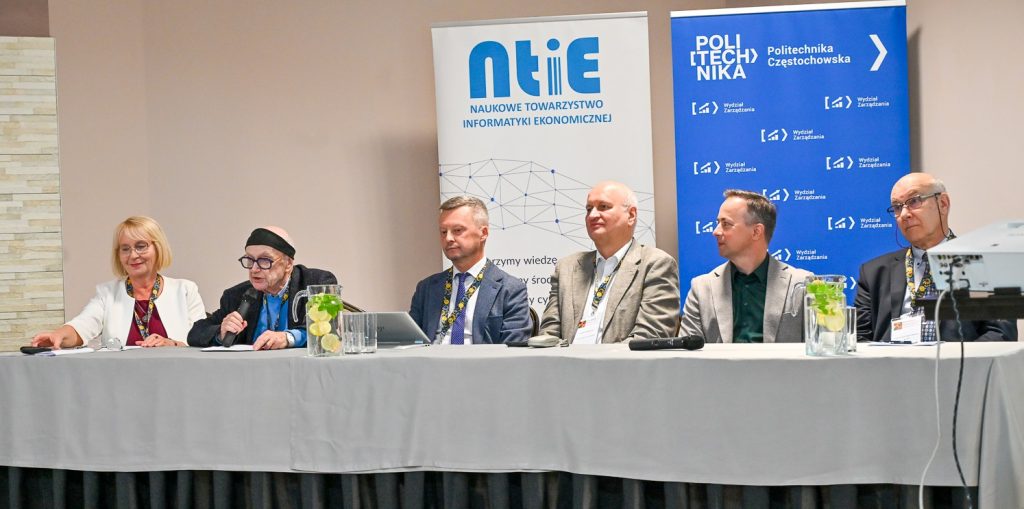
On October 8–9, 2026, the 13th International Scientific Conference “Knowledge and Information Technologies in Creating Entrepreneurship” took place in Olsztyn near Częstochowa, Poland. The annual event brought together researchers in the field of business informatics. This year’s discussions focused on digital transformation and artificial intelligence.
Prof. Krzysztof Węcel was invited to participate in a panel discussion entitled “Directions for Enterprise Digital Transformation: Challenges and Best Practices”. The panel also featured Prof. Jerzy Kisielnicki, Prof. Zbigniew Pastuszak (Maria Curie-Skłodowska University in Lublin), Prof. Paweł Lula (Krakow University of Economics), Prof. Katarzyna Rostek (Warsaw University of Technology), and Prof. Janusz Zawiła-Niedźwiecki (Warsaw University of Technology). The discussion was moderated by Prof. Dorota Jelonek (Częstochowa University of Technology).
Prof. Węcel structured his contribution around the metaphor of a “new employee”. In his thought experiment, this new employee was an AI agent expected to shape the direction of digital transformation in the coming years. He argued that technology itself is no longer the main bottleneck — the real challenge now lies within organizations. He identified three essential shifts that companies need to make. The first is a shift from tools to agents. Companies still tend to treat AI agents as tools, whereas they should increasingly be regarded as members of the team. The second is a shift from data to knowledge. Data alone is not enough for an AI agent; it also needs to understand what that data means. An organization that does not know what it knows cannot pass that knowledge on to an AI agent. The third is a shift from efficiency to trust. AI agents are not yet able to reliably distinguish between true and false information. The next wave of technological development will therefore focus on trust-enabling technologies, including content provenance verification, labeling of AI-generated materials, automated disinformation detection, and blockchain-based recordkeeping. Prof. Węcel concluded that trust management is likely to become a core organizational function in the future, much as quality management did in the past.
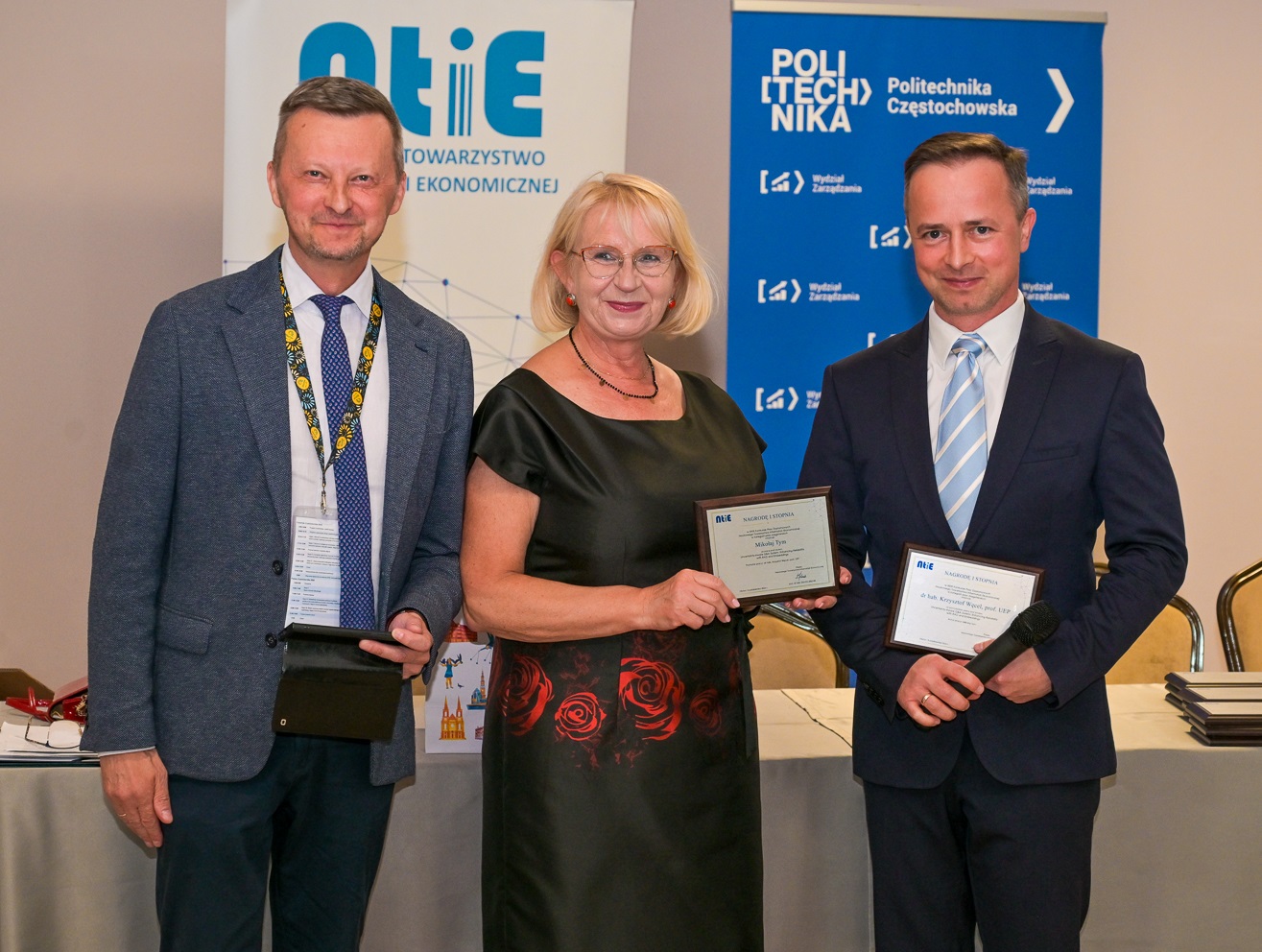 Before the gala dinner, an award ceremony was held to recognize the best doctoral, master’s, and bachelor’s theses in the field of business informatics, as part of a competition organized by the Scientific Society for Business Informatics (NTIE). Poznań University of Economics and Business received more distinctions than any other university. Awards were accepted by members of our department: Prof. Agata Filipowska, Mikołaj Tym and Prof. Krzysztof Węcel. Further details were published previously.
Photos from the conference: konferencja.czest.pl/galeria-2026/